Download PDF
The visibility of the on the internet publication or soft file of the will reduce individuals to get guide. It will certainly likewise save more time to only browse the title or writer or publisher to obtain up until your publication is revealed. Then, you could go to the link download to go to that is provided by this site. So, this will certainly be an excellent time to start appreciating this book to read. Always great time with publication , always good time with cash to spend!

Download PDF
Is publication your preferred reading? Is fictions? Exactly how's concerning record? Or is the very best vendor novel your selection to satisfy your downtime? Or even the politic or spiritual books are you searching for currently? Right here we go we offer book collections that you need. Lots of varieties of publications from many fields are given. From fictions to scientific research and also religious can be looked and also found out here. You could not stress not to locate your referred book to review. This is one of them.
However, when a publication is preferred, it will run out promptly. It is just one of the issues that you have to think about. After walking for much ranges to get this publication, it will certainly not guarantee you to discover it. In some cases, you will certainly not find it in some racks. So, it will certainly be much better for you to obtain guide in this area. By only clicking the web link and also find guide swiftly, you can wait and also begin to check out. This is just what you can really feel so relieved to earn better for obtaining the qualified source to check out.
You may not have to be question regarding this It is uncomplicated method to obtain this publication You can just check out the set with the web link that we supply. Here, you can buy the book by online. By downloading , you can discover the soft data of this book. This is the local time for you to start reading. Also this is not published publication ; it will specifically provide even more advantages. Why? You might not bring the published book or stack the book in your property or the office.
You could change your mind to be much better after obtaining the resources from some documents. Yet when you have the sources from this publication, you could take just how different this publication sight from others. Yeah, this is exactly what makes you really feel completed to conquer the function of the sources. becomes one recommendation that supplies the existence of brand-new details as well as ideas. Now, your time is for obtaining the book faster. This is it the book that you need currently!
Product details
File Size: 337697 KB
Print Length: 480 pages
Publisher: Wiley; 5 edition (April 16, 2014)
Publication Date: April 16, 2014
Sold by: Amazon Digital Services LLC
Language: English
ASIN: B00JRYDAIY
Text-to-Speech:
Enabled
P.when("jQuery", "a-popover", "ready").execute(function ($, popover) {
var $ttsPopover = $('#ttsPop');
popover.create($ttsPopover, {
"closeButton": "false",
"position": "triggerBottom",
"width": "256",
"popoverLabel": "Text-to-Speech Popover",
"closeButtonLabel": "Text-to-Speech Close Popover",
"content": '
});
});
X-Ray:
Not Enabled
P.when("jQuery", "a-popover", "ready").execute(function ($, popover) {
var $xrayPopover = $('#xrayPop_92A79066433211E9A0AD284C406DAADB');
popover.create($xrayPopover, {
"closeButton": "false",
"position": "triggerBottom",
"width": "256",
"popoverLabel": "X-Ray Popover ",
"closeButtonLabel": "X-Ray Close Popover",
"content": '
});
});
Word Wise: Not Enabled
Lending: Not Enabled
Enhanced Typesetting:
Enabled
P.when("jQuery", "a-popover", "ready").execute(function ($, popover) {
var $typesettingPopover = $('#typesettingPopover');
popover.create($typesettingPopover, {
"position": "triggerBottom",
"width": "256",
"content": '
"popoverLabel": "Enhanced Typesetting Popover",
"closeButtonLabel": "Enhanced Typesetting Close Popover"
});
});
Amazon Best Sellers Rank:
#233,725 Paid in Kindle Store (See Top 100 Paid in Kindle Store)
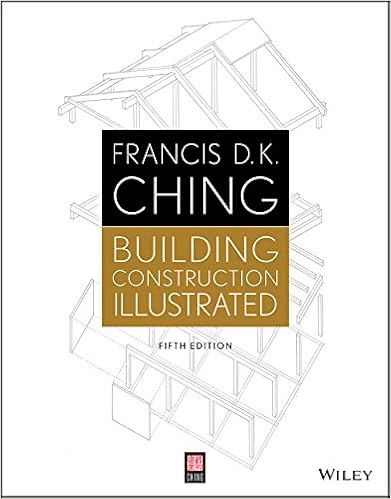
The cover of Building Construction Illustrated by Francis D. K. Ching shows the skeleton of a house in exploded form. That is in essence what the book is about; taking a building apart and explaining what each element is and what requirements are imposed for the type of construction shown. Every page is covered with excellent drawings - there are no photographs at all - and detailed explanations of what the reader is looking at.Mr. Ching deals with buildings as systems. For example, Floor Systems. Then he shows wood joists and explains the span ranges for wood joists; such as, 2 x 6 up to ten feet. Helpful hints are included, "Rule of thumb for estimating joist depth: span/ 16," and "Joist deflection should not to exceed 1/360 th of span." (There may have been some translation problems in that example).Thus, it is a book filled with facts about construction. Critical facts that anyone in the construction industry must know. It is not a book to be read like a school text or encyclopedia. It is much more like a dictionary or reference book with all the facts gathered together in sections. If you were looking for the construction standards for roofing you would consult the Roof Systems section. Almost everything concerning frame construction is covered with exacting diagrams for every system.This is not is a book telling someone how to do something. A construction manager would find the book of little value. An architect would use this as a reference manual, but someone learning how to build a wall would find only momentary items of interest. It is not a how to manual in any fashion. It shows drawings of walls and gives critical information about measurements and requirements of good construction, but whether toenailing or nailing from the opposite side of the 2x4 is better isn't there. What hammer to pick for the nailing job will not be found in this book. Some of the subchapters are really just overviews of the major concerns, such as the site layout section. It is very brief.One thing I find missing is recommendations for improving construction techniques or practices. In the section on high rise structures nothing is said about what method is better or how evolving materials might make certain construction techniques better than others. The obsolescence of some materials isn't discussed. Of course, only modern structures are covered. No comparisons are made with 1890 skyscrapers.Being a reference book, in my opinion, the index should be massively expanded. The index is 10 pages long. While 10 pages might seem like a large index the book itself is large and the index does not reflect the depth of information available in the book. The main Table of Contents needs to be expanded far beyond what it is now. Instead of just listing "Wall Systems" it needs to break the chapter down into at least its major subchapters just as they do at the beginning of each chapter. Searching for information is much more time consuming when one has to go to each chapter to find a summary of what topics are covered. That should also be in the main Table of Contents.The book does not have page numbers. Everything is referred to under the chapter number and then the page within the chapter. Thus, Precast Concrete Connections 4.13 refers to chapter 4 page 13 of that chapter. While it is an efficient system unless one is familiar with it quoting sections to people unfamiliar with the concept leads to confusion. Thus, "see page 5.11" comes across as see page 511 (five hundred and eleven) to the initiated.Thus, while the illustrations are outstanding and the text terse but effective, more effort is needed to make finding things in the book easier. People familiar with construction will know adobe construction is found under walls, but someone unfamiliar with the business would not.AD2
I have been searching for books that guide the reader through the design of an ideal home. I purchased BUILDING CONSTRUCTION ILLUSTRATED, by Francis Ching, because of its large reader base and exceptionally favorable reviews.Based on my search, I rate this book as best in its class, i.e., among books that help architects to prepare drawings for commercial building construction.However, this is not a practical book for designing, renovating, or repairing a home. I suggest two books that are more useful for readers with a residential interests.WHAT IT CONTAINSChing’s book is primarily a catalog of detail drawings, arranged in these chapters:1. The Building Site2. General Structural Issues3. Foundations4. Floors5. Walls6. Roofs7. Moisture & Thermal Protection8. Doors & Windows9. Stairs, Fireplaces, Space Layout, etc.10. Interior Finishes11. HVAC & Electrical12. Materials & FastenersAPPENDIX. Dimensions, Loads, Fire Protection, Noise, etc.The book has about 500 pages. The drawings number in the thousands, so there is a lot of information on each page. I can’t imagine any other construction book that has a greater volume of sheer detail.The drawings are extensively annotated. The annotations are as important as the drawings themselves, providing an education about each assembly.In addition to the detail drawings, Ching includes a number of illustrated tutorials on various topics, such as structural forces, that are informative and well rendered.Unfortunately, in this fifth edition, the text is almost illegibly small and light. The spidery font is a disaster. Even with strong glasses and good lighting, reading the text is a chore. Also, the graphics tend to be somewhat too small. The book is printed entirely in monotone black, or maybe it’s dark grey. These flaws seriously undermine the usability of the book.WHAT IT ISN’TChing’s book is not a design guide. It is like a trunk full of building blocks that contains no guidance in assembling the blocks. Ching does not distinguish between methods and materials of different merit. For example, the book passes no judgement on flat roofs, active and passive solar heating, and forced-air heating, all of which have serious shortcomings.Also, it provides only limited coverage of fundamental design issues, including energy efficiency, comfort, and indoor health.This book is not for residential applications. Its attempt to cover both commercial and residential construction proves to be impractical. The two worlds of construction have little commonality of methods or materials. The great bulk of this book is oriented toward commercial construction, for example, with coverage of heavy steel and concrete structures. Someone who is designing a home would have to search for needles of useful information in this haystack.BETTER BOOKS FOR RESIDENTIAL DESIGN & CONSTRUCTIONFor those interested in residential design and construction, I recommend two books that are more useful, and certainly more accessible, than Ching’s book.The best design guide for homes is SUPER HOUSE: DESIGN YOUR DREAM HOME FOR SUPER ENERGY EFFICIENCY, TOTAL COMFORT, DAZZLING BEAUTY, AWESOME STRENGTH, AND ECONOMY, by Donald Wulfinghoff. This uniquely user-friendly guide uses eight “Steps†to create an ideal home from foundation to roof, or to deal with any individual part of a house, such as replacing the windows. It goes straight to the most desirable methods and materials, ignoring the rest. It pursues energy efficiency, comfort, health, strength, and durability throughout. Also, it warns the reader of commonplace bad practices to avoid.The best comprehensive reference book for residential construction data is THE VISUAL HANDBOOK OF BUILDING AND REMODELING, by Charlie Wing. It illustrates residential structures and materials in great depth, but offers no systematic design guidance.The diagrams and formatting of both books use color very effectively. In addition, SUPER HOUSE uses hundreds of color photographs to illustrate good and bad practices.
I have found the two earlier editions on my shelf to be absolutely invaluable ~ they are disintegrating from heavy use. But, I'm afraid that the old ones will wear even more, because the hair line print, both the text and the drawings in this edition (undoubtedly the best edition yet for content) is a chore. I don't know what they were thinking ~ going green by saving ink? I'm going to try to adapt to the pale gray but I'm not optimistic about succeeding. A return may ultimately be in order along with the purchase of a new copy of an older more legible edition. Two point five stars for now, but will re-comment if I find it to be keeper.OK --- this is an addendum to above: The fifth edition is for me NOT a keeper - I've given it to a friend who has only rare need for this type of reference material, in contrast to my frequent need and use. I have normal eyesight, and the text in the fifth edition is both pale and diminutive to such an extent that I find it illegible in any practical sense. I'm very disappointed in that I was eagerly looking forward to this new edition. The drawings are usable, but taxing for the same reasons. What we have is Beethoven's Fifth delivered underwater. What a bummer! Two stars.
PDF
EPub
Doc
iBooks
rtf
Mobipocket
Kindle

0 komentar:
Posting Komentar